×

Managing supplier invoices, approvals, and payments is a daily challenge for finance teams. Yet many UAE businesses still rely on spreadsheets and manual data entry. This is both time-consuming and error-prone.
Accounts payable software changes this completely. It automates the entire invoice lifecycle — from receipt to final payment. As a result, businesses save time, reduce errors, and stay audit-ready.
In 2026, the stakes are even higher. The UAE's e-invoicing mandate is approaching fast. FTA regulations are tightening. And finance teams need smarter tools to keep up. That is why choosing the best accounts payable automation software matters more than ever.
The UAE economy is growing at a rapid pace. Businesses are expanding across Emirates, free zones, and GCC markets. With this growth comes greater complexity in managing vendor payments.
Manual processes cannot keep up. Delayed approvals, missed deadlines, and compliance risks are common problems. AP automation solves all three at once. Moreover, the FTA's e-invoicing rollout is pushing businesses to upgrade their systems now. Waiting is not an option for companies that want to remain compliant and competitive.
Manual AP is costly — in both time and money. Studies show it costs up to AED 75 to process a single invoice manually. With automation, that cost drops by up to 80%. Beyond direct costs, manual processes also create hidden risks. Duplicate payments, lost invoices, and poor audit trails can invite FTA scrutiny. These are problems that no finance team wants to face.
Managing vendor invoices manually is slow and risky. Accounts payable automation software replaces every manual step with a faster, smarter digital process. Here is how it works, from start to finish.
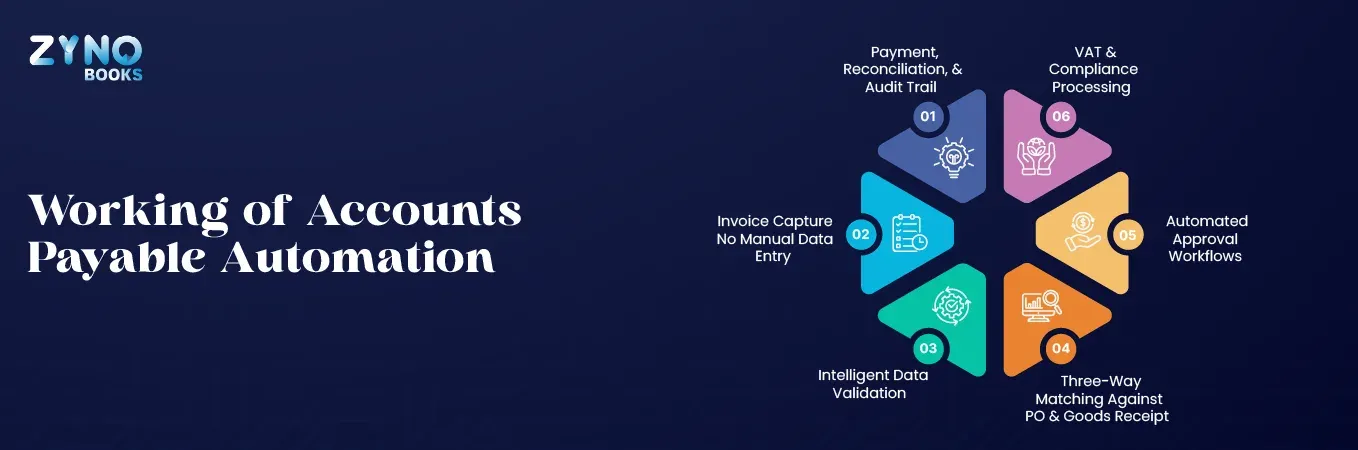
Every AP cycle begins when a supplier invoice arrives. The system captures it instantly via email, upload, or e-invoicing portal. OCR extracts the vendor name, invoice number, VAT amount, and total automatically. No manual typing. No entry errors.
Once captured, the system validates all extracted data. It checks the supplier's TRN, confirms the currency, and verifies VAT treatment. Anything unusual — a duplicate number or unfamiliar bank account — is flagged immediately. Nothing moves forward until everything is verified and clean.
The system compares the invoice against the purchase order and goods receipt note. If quantities, prices, and vendor details align, it moves forward automatically. Any discrepancy holds the invoice and alerts the right team member — preventing duplicate payments and overpayments.
Invoices are routed digitally to the right approvers based on rules you define — by amount, department, or vendor type. Approvers act from any device, anywhere. If no response comes in time, the system sends reminders and escalates automatically.
The system identifies invoice type, applies the correct VAT rate, and handles RCM entries automatically. No manual input needed. Every transaction is processed in line with FTA requirements — keeping your books fully compliant at every step, without relying on your team.
Once approved, payment is scheduled and released based on agreed terms. The system reconciles it instantly against the open invoice. Every action — approval, payment, account details — is logged securely. Your audit trail is always complete and ready for FTA inspection.
Three core technologies power modern AP automation tools. These are Optical Character Recognition (OCR), Artificial Intelligence (AI), and E-Invoicing frameworks.
Optical Character Recognition (OCR) OCR scans incoming invoices — PDFs, images, or scanned documents — and extracts key data automatically. It reads vendor names, invoice numbers, VAT amounts, and totals instantly. This eliminates manual data entry and significantly reduces human errors in the AP process.
Artificial Intelligence (AI) AI goes beyond reading invoices. It learns from past transactions, detects duplicates, flags anomalies, and validates data against your vendor records. Over time, it gets smarter — improving accuracy, speeding up approvals, and reducing the need for manual intervention in routine AP tasks.
E-Invoicing E-invoicing enables direct digital transmission of invoices between buyer and supplier systems. Invoices are structured in UBL or XML formats, making them machine-readable and FTA-compliant. For UAE businesses, this technology is central to meeting the upcoming 2026–2027 e-invoicing mandate requirements.
Together, these technologies eliminate manual data entry entirely. The result is faster processing and fewer errors.
Manual data entry is one of the biggest bottlenecks in finance. Even a small error in a vendor account number can delay payment by days. Automation removes this risk by capturing data directly from source documents.
Approval workflows are also automated. Invoices are routed to the right approvers based on preset rules. Reminders are sent automatically. And reconciliation happens in real time, not at month-end.
The list is as follows-
UAE VAT has been in place since 2018. Yet many businesses still struggle with compliant invoice processing. The Federal Tax Authority (FTA) has strict requirements for both full and simplified tax invoices.
Every FTA approved accounting software in UAE must capture VAT correctly. It must also generate proper tax invoices with the required fields — TRN number, VAT amount, invoice date, and more.
The UAE e-invoicing mandate is one of the biggest regulatory changes in recent years. The pilot phase begins in July 2026. Full rollout follows in 2027.
Under this mandate, businesses must exchange invoices digitally through accredited service providers (ASPs). All invoices must follow UBL or XML standards. Paper and PDF invoices will no longer be sufficient.
This means AP software must be ready to receive, validate, and process e-invoices automatically. Any delay in compliance can result in significant penalties.
The UAE introduced Corporate Tax in June 2023. This adds another layer of documentation requirements for businesses. All transactions must be properly recorded and linked to valid invoices.
Accounting software Dubai businesses use must support these requirements. The best AP tools integrate VAT and corporate tax reporting in a single dashboard.
The Reverse Charge Mechanism (RCM) applies when UAE businesses receive services from foreign suppliers. Under RCM, the buyer is responsible for reporting and paying VAT — not the supplier.
Effective January 2026, new FTA guidelines clarify RCM applicability further. AP software must identify RCM transactions automatically and post the correct journal entries. Manual tracking of RCM is increasingly risky.
UAE tax law requires businesses to retain financial records for at least five years. This includes all invoices, payment receipts, and supporting documents. Failure to maintain records can attract FTA penalties. A good accounts payable software stores all documents digitally with full audit trails. This makes it easy to retrieve records during an FTA inspection — without hours of manual searching.
The main features in AP automation software are-
Not all invoices in the UAE are the same. Full tax invoices are required for B2B transactions above AED 10,000. Simplified tax invoices are used for smaller amounts. Your AP software must handle both correctly. Look for tools that auto-detect invoice type and apply the correct VAT treatment. This reduces the risk of filing errors with the FTA.
UAE businesses often work with international suppliers. Invoices arrive in USD, EUR, GBP, and other currencies. Your AP software must convert these accurately using real-time exchange rates. AED must also be the base currency for VAT reporting. Ensure your software handles currency conversion and reporting in full compliance with FTA rules.
A proper audit trail is non-negotiable. Your software must log every action — who approved what, when, and why. This is essential for FTA audits and internal reviews alike. Look for pre-built FTA VAT return reports. These save hours of manual work and reduce the risk of miscalculation.
Many UAE vendors issue invoices in Arabic. Some government entities also require Arabic documentation. Your AP software should support both Arabic and English — ideally on the same invoice.
AP software does not work in isolation. It must integrate with your existing ERP or accounting system. ZYNO Books is the Popular choice in the UAE. Poor integration leads to duplicate data entry and reconciliation headaches. Always verify that your chosen AP tool connects smoothly with your current tech stack.
UAE companies often have multi-level approval structures. Invoices above certain thresholds may need department head, CFO, and CEO approvals. Your AP software should support customisable approval chains. This is especially important for companies with offices across multiple Emirates or free zones.
Data residency is a growing concern for UAE businesses. Some sectors — like government, banking, and healthcare — require data to be stored within the UAE. Verify where your AP software hosts its data before signing any contract.
Choosing the right tool is critical. Here is a comparison of the top accounts payable automation software options available to UAE businesses in 2026.
ZYNO Books, developed by Elite Mindz, is purpose-built for UAE businesses. It handles the full AP cycle — invoice capture, VAT validation, approval workflows, and payment processing — in one platform.
It is designed to meet FTA requirements out of the box. It supports both full and simplified tax invoices, RCM entries, and the upcoming e-invoicing mandate. It is one of the most comprehensive FTA approved accounting software in UAE options available today.
Zoho Books is a popular choice for SMEs in the UAE. It offers VAT compliance, multi-currency support, and integration with the wider Zoho ecosystem. However, it may require customisation for complex AP workflows.
QuickBooks is well-known globally. The UAE version includes VAT support. But its AP automation features are limited compared to dedicated tools. It works best for small businesses with straightforward invoice volumes.
Xero is a cloud-based accounting tool with strong AP features. It integrates well with third-party tools and offers clean dashboards. However, it has limited Arabic support and may not fully align with all FTA requirements.
Tipalti is ideal for companies that pay international vendors at scale. It handles global payments in 196 countries and 120 currencies. However, it is better suited to large enterprises than UAE SMEs.
SAP Concur is a powerful enterprise AP platform. It offers deep integration with SAP ERP and advanced analytics. The complexity and cost make it better suited to large multinationals with complex operations.
Pluto is a UAE-born spend management platform licensed by DIFC. It focuses on corporate card management and expense automation. It is a good fit for businesses looking to manage employee spending alongside AP processes.
Alaan is another UAE-based platform with a focus on spend visibility and vendor payments. It is growing in popularity among UAE startups and SMEs looking for modern, mobile-first AP solutions.
The list of varied business types are-
Free zone companies often handle a high volume of cross-border transactions. They need AP software that supports multi-currency invoicing, zero-rated VAT, and fast onboarding. Best accounting software in Dubai for SMEs should be cloud-based, affordable, and easy to set up.
Mid-market businesses with multiple entities need consolidated AP reporting. They also need entity-level approval workflows. The right AP tool should support intercompany transactions and provide a unified view across all entities.
Large enterprises need enterprise-grade AP automation with ERP integration, advanced analytics, and GCC-wide compliance. Tools like SAP Concur or ZYNO Books with enterprise tiers are well-suited for this segment.
Different industries have unique AP needs. Real estate companies manage large volumes of contractor invoices. Construction firms deal with milestone-based payments. Retail businesses need fast supplier payment cycles. Healthcare companies must maintain strict procurement records. Choose AP software that understands your industry.
The Ministry of Finance has confirmed the UAE e-invoicing rollout timeline. The voluntary pilot phase begins in July 2026. Mandatory compliance follows in 2027 for all registered businesses.
Businesses that start preparing now will avoid last-minute scrambles. Early adoption also provides a competitive advantage in supplier relationships and financial reporting.
An Accredited Service Provider (ASP) is a technology company authorised by the UAE government to process and transmit e-invoices. Businesses cannot send e-invoices directly to each other. They must route them through an ASP. Your AP software must integrate with an ASP. Without this integration, you will not be able to send or receive compliant e-invoices after the mandatory deadline.
UAE e-invoices must follow Universal Business Language (UBL) or XML standards. These are structured data formats that ensure all invoice fields are machine-readable. Your AP software must generate and accept invoices in these formats. It must also validate incoming invoices against these standards before posting them to your books.
The FTA has outlined strict penalties for non-compliance with e-invoicing requirements. Businesses face a base fine of AED 5,000 per month for non-compliance. Additional per-invoice fines also apply. These penalties can accumulate quickly, especially for high-volume businesses. Investing in compliant AP software now is far cheaper than paying fines later.
Start by understanding your current AP workload. How many invoices do you process per month? How many vendors do you have? What currencies do they invoice in? These answers will narrow your software choices significantly.
This is non-negotiable. Any accounting software Dubai businesses consider must be fully VAT-compliant. Check if the software generates FTA-compliant tax invoices, supports VAT returns, and handles RCM automatically.
Your AP software must talk to your existing systems. Poor integration creates data silos and manual reconciliation work. Always test integration before committing to any platform.
If you plan to expand into Saudi Arabia, Bahrain, or Kuwait, ensure your AP software supports GCC tax frameworks. Look for tools that are already used across the region, not just in the UAE.
Every AP automation investment should have a clear ROI. Calculate your current cost per invoice, multiply by monthly volume, and compare it to the software's annual cost. Most businesses see ROI within six months of switching to automation.
Some of the major challenges are:-
Duplicate payments are more common than most finance teams realise. A supplier sends the same invoice twice. Or a team member re-enters an invoice that was already processed. AP automation catches duplicates automatically using invoice matching logic.
Fraud detection is also stronger with automation. The system flags unusual patterns — like new bank account details on a known vendor — for human review before payment.
UAE businesses often have approvers spread across multiple locations. An invoice waiting for approval in someone's email inbox can delay payment by days or weeks. Automated approval workflows ensure invoices are routed, escalated, and resolved on time — regardless of location.
Multi-currency payments are a daily reality for UAE businesses. Manual FX conversion is slow and error-prone. AP automation tools convert currencies automatically and post the correct AED equivalent for VAT reporting.
FTA audits can happen at any time. Businesses must be able to produce original invoices, approval records, and payment histories on short notice. A good accounts payable software maintains a complete digital audit trail, making inspections stress-free.
Among all the accounts payable automation software options in the UAE, ZYNO Books stands out for one key reason: it was built specifically for UAE compliance from day one. Most global tools are adapted for the UAE market as an afterthought. ZYNO Books was designed with FTA requirements, VAT rules, and UAE business workflows at its core.
ZYNO Books automates every stage of VAT processing. When an invoice is received, the system reads the invoice type — full or simplified. It then extracts VAT amounts, validates the supplier's TRN, and applies the correct VAT rate.
For RCM transactions, ZYNO Books identifies the reverse charge obligation automatically. It posts the required journal entries without any manual input. This reduces the risk of VAT miscalculation significantly.
At quarter-end, ZYNO Books generates a pre-filled VAT return report. Finance teams can review and submit directly to the FTA portal. The entire process takes minutes, not days.
ZYNO Books offers fully customisable approval workflows. You can set rules based on invoice amount, vendor category, or cost centre. Invoices are routed automatically to the right approvers.
If an approver does not act within a set timeframe, the system sends reminders and escalates as needed. This ensures no invoice sits idle in an inbox.
Real-time dashboards give finance managers full visibility into the AP pipeline. You can see total pending approvals, upcoming payment due dates, and outstanding liabilities at a glance. This level of visibility is what separates the best accounting software in Dubai from basic bookkeeping tools.
ZYNO Books is fully prepared for the UAE e-invoicing mandate. The platform generates invoices in UBL and XML formats. It is designed to integrate with accredited service providers (ASPs) as the mandate rolls out.
Businesses using ZYNO Books today will not need to change their AP processes when e-invoicing becomes mandatory in 2027. The transition will be seamless.
ZYNO Books is not just another piece of automotive accounting software with a UAE plug-in. It is a purpose-built platform that understands the UAE business environment deeply.
From free zone companies processing import invoices to Dubai-based trading companies managing dozens of vendors — ZYNO Books handles it all. Its intuitive interface means your team can get started quickly, without weeks of training.
And because it is cloud-based, your finance team can access it from anywhere. Approvals happen on mobile. Reports are available in real time. Your accounts payable process is always under control.
The accounts payable function is transforming fast. AI is making invoice processing smarter. E-invoicing is making the process more transparent. And UAE regulators are raising the bar for compliance every year.
Businesses that invest in the right AP automation tools today will be better positioned for what comes next. Whether it is a new FTA requirement, a GCC expansion, or rapid business growth — the right software will keep you ahead.
ZYNO Books is a product of Elite Mindz, a leading technology solutions company. Elite Mindz specialises in building financial and business management software that meets the real-world needs of UAE companies.
With a deep understanding of FTA regulations, UAE corporate tax rules, and the fast-changing e-invoicing landscape, Elite Mindz has built ZYNO Books to be the most UAE-relevant accounts payable software on the market.
From fast-growing startups in Dubai Internet City to established enterprises in Abu Dhabi, businesses across the UAE trust ZYNO Books to manage their accounts payable with accuracy, speed, and full compliance.
Ready to Transform Your Accounts Payable? Book a Free Demo of ZYNO Books Today
Is AP automation software mandatory in the UAE?
AP automation is not yet mandatory in the UAE. However, the upcoming e-invoicing mandate (starting July 2026 pilot) will require businesses to process invoices digitally. Using AP automation software now will make this transition much smoother.
What is the penalty for non-compliant invoices in the UAE?
The FTA can impose fines of AED 5,000 per month for non-compliance with e-invoicing requirements. Additional per-invoice penalties also apply. Businesses that fail to maintain proper records face further fines under UAE tax law.
Can small businesses in the UAE afford AP automation?
Yes. Many accounts payable automation software options — including ZYNO Books — offer flexible pricing that suits small and growing businesses. The cost of automation is typically far lower than the cost of manual processing errors and compliance failures.
How does AP automation support FTA audits?
AP automation maintains a complete digital audit trail of every invoice, approval, and payment. When the FTA requests records, businesses can retrieve them instantly. This significantly reduces the stress and risk associated with tax audits.
Does ZYNO Books support UAE e-invoicing requirements?
Yes. ZYNO Books is designed to support UAE e-invoicing requirements. It generates invoices in UBL and XML formats and is built to integrate with accredited service providers (ASPs) as the e-invoicing mandate rolls out in 2026 and 2027.
What is the best accounting software in Dubai for SMEs?
For SMEs in Dubai, ZYNO Books and Zoho Books are among the top choices. Both offer UAE VAT compliance, multi-currency support, and cloud access. ZYNO Books has the added advantage of being built specifically for the UAE market, making it the stronger choice for local compliance needs.
Are you looking for a professional advisor for your business?
Complete the form and discuss implementation strategies with our IT expertise.
Get a Quote in Minutes
(1).webp)
The Ultimate Guide to Managing Your Business with ZYNO Books
Read More →.webp)
Why Is 206CR of Income Tax Act Important for Businesses in India?
Read More →.png)
The Best Accounting Software in Saudi Arabia
Read More →
Managing Multi-Country Taxes Made Easy with ZYNO Books Integrations
Read More →
Why TRN Validation is Essential for VAT Compliance in the UAE
Read More →
Best Accounts Payable Automation Software
Read More →










Experience smart, automated accounting—share your details and our team will guide you with a personalized demo.